In Memoriam — January 28, 1986
STS-51-L
Challenger Memorial
January 28, 1986
Challenger (OV-099) — KSC LC-39B
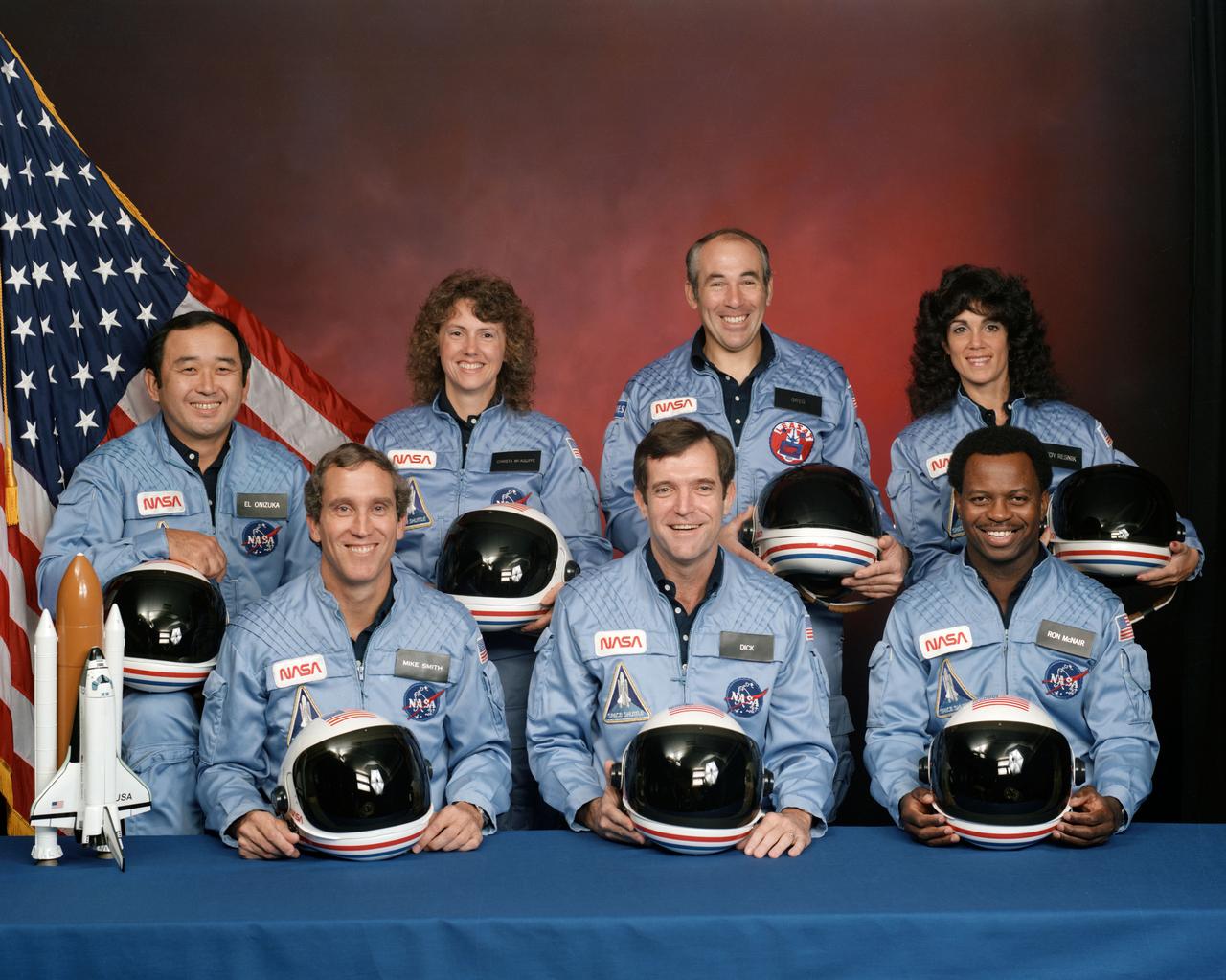
On January 28, 1986, the Space Shuttle Challenger broke apart 73 seconds after launch from Kennedy Space Center, killing all seven crew members. Commander Francis “Dick” Scobee, Pilot Michael Smith, Mission Specialists Judith Resnik, Ellison Onizuka, and Ronald McNair, Payload Specialist Gregory Jarvis, and Teacher in Space participant Christa McAuliffe were lost when a catastrophic failure in the right Solid Rocket Booster tore the orbiter apart at an altitude of 48,000 feet.
The mission, designated STS-51-L, carried enormous public attention because of Christa McAuliffe, a high school social studies teacher from Concord, New Hampshire, who had been selected from over 11,000 applicants to be the first private citizen in space. Millions of schoolchildren watched the launch live on television. What should have been a moment of triumph became a national tragedy witnessed in real time.
The seven who perished that cold January morning represented the best of America’s astronaut corps — military test pilots, a physicist, an electrical engineer, a satellite engineer, and a schoolteacher. Their diverse backgrounds embodied NASA’s vision that space belonged to everyone. Their sacrifice forced a reckoning with complacency and led to fundamental changes in how America approaches human spaceflight.
The mission, designated STS-51-L, carried enormous public attention because of Christa McAuliffe, a high school social studies teacher from Concord, New Hampshire, who had been selected from over 11,000 applicants to be the first private citizen in space. Millions of schoolchildren watched the launch live on television. What should have been a moment of triumph became a national tragedy witnessed in real time.
The seven who perished that cold January morning represented the best of America’s astronaut corps — military test pilots, a physicist, an electrical engineer, a satellite engineer, and a schoolteacher. Their diverse backgrounds embodied NASA’s vision that space belonged to everyone. Their sacrifice forced a reckoning with complacency and led to fundamental changes in how America approaches human spaceflight.
“The crew of the Space Shuttle Challenger honored us by the manner in which they lived their lives. We will never forget them, nor the last time we saw them, this morning, as they prepared for their journey and waved goodbye and slipped the surly bonds of Earth to touch the face of God.”
— President Ronald Reagan, January 28, 1986
The Crew
What Happened
The Cold Morning
The morning of January 28, 1986, was bitterly cold at Kennedy Space Center, with temperatures dropping to 36°F (2°C) overnight — well below the design limits of the Solid Rocket Booster (SRB) O-ring joints. Engineers at Morton Thiokol, the SRB manufacturer, had warned NASA the previous evening that the cold temperatures posed a serious risk to the rubber O-rings that sealed the joints between the booster segments. The O-rings were designed to prevent superheated combustion gases from escaping, but laboratory tests showed they lost resiliency at low temperatures. Despite these warnings, NASA managers overruled the engineers and proceeded with the launch.Challenger had already been delayed six times. Pressure to maintain the launch schedule, combined with institutional overconfidence, led decision-makers to discount the engineers’ concerns. It was a failure not of technology alone, but of management culture.
73 Seconds
At 11:38 AM EST, Challenger lifted off from Launch Complex 39B. Within the first second, photographic analysis would later reveal that hot gases began escaping through the right SRB’s aft field joint, where the O-ring had failed to seal. A plume of flame flickered and then appeared to be temporarily halted by aluminum oxide deposits. For 58 seconds the leak seemed contained.At T+59 seconds, however, the breach reopened. A jet of flame burned through the SRB casing and impinged directly on the External Tank, weakening its structural wall and the lower strut attaching the SRB. At T+72 seconds, the lower SRB strut failed, and the SRB pivoted into the External Tank. The hydrogen tank ruptured. At T+73 seconds, the External Tank disintegrated in a massive fireball as liquid hydrogen and liquid oxygen mixed. Challenger was torn apart by aerodynamic forces at a velocity of Mach 1.92 at an altitude of 48,000 feet.
The crew cabin remained largely intact and continued ascending briefly before beginning a long fall to the ocean. Three of the crew’s Personal Egress Air Packs were found to have been activated, indicating at least some crew members survived the initial breakup. The cabin struck the Atlantic Ocean approximately two minutes and forty-five seconds later at roughly 200 mph, a force not survivable. The wreckage was recovered from the ocean floor over the following weeks.
The Rogers Commission
President Reagan appointed a Presidential Commission chaired by former Secretary of State William P. Rogers to investigate the disaster. The commission included physicist Richard Feynman, astronaut Sally Ride, and test pilot Chuck Yeager, among others. Feynman’s famous demonstration — dunking an O-ring segment in a glass of ice water during a televised hearing to show it lost flexibility in the cold — became one of the most iconic moments in the history of scientific investigation.The Rogers Commission report, released on June 9, 1986, concluded that the disaster was caused by the failure of an O-ring seal in the right SRB’s aft field joint, exacerbated by the cold temperature at launch time. But the report went further, identifying a deeply flawed decision-making process at NASA. The Commission found that NASA managers had known about the O-ring vulnerability for years — it had been flagged as a “Criticality 1” item, meaning failure could result in loss of crew and vehicle — yet had repeatedly accepted the risk without adequately addressing it. The report cited a “silent safety program” and organizational culture that suppressed engineering dissent.
Legacy
Reforming NASA
The Challenger disaster forced the most significant transformation of NASA’s safety culture since the Apollo 1 fire. The Space Shuttle program was grounded for 32 months while sweeping changes were implemented:• The Solid Rocket Booster joints were completely redesigned with a new tang-and-clevis configuration, a third O-ring, and electric heaters to ensure the seals functioned properly in cold weather
• NASA established an independent Office of Safety, Reliability, and Quality Assurance, reporting directly to the NASA Administrator rather than through program management
• Launch decision criteria were revised to require all levels of engineering to affirmatively certify flight readiness, rather than requiring dissenters to prove it was unsafe
• A crew escape system was added, allowing astronauts to bail out during controlled gliding flight (though not during powered ascent)
• The Shuttle flight rate was reduced and plans to launch from Vandenberg Air Force Base were cancelled
• NASA stopped carrying commercial payloads on the Shuttle, returning that role to expendable launch vehicles
The Challenger Centers
In 1986, the families of the Challenger crew founded the Challenger Center for Space Science Education to continue the educational mission that Christa McAuliffe had championed. Today, over 40 Challenger Learning Centers across the United States, Canada, South Korea, and the United Kingdom provide simulated space missions for students. More than 5 million young people have participated in Challenger Center programs, directly fulfilling the crew’s belief that space exploration should inspire the next generation.Remembering
Each January, NASA holds a Day of Remembrance honoring the crews of Apollo 1, Challenger, and Columbia. The Space Mirror Memorial at Kennedy Space Center Visitor Complex bears the names of all astronauts who died in the line of duty, their names cut through the polished granite so that sunlight shines through, symbolizing their enduring light.Craters on the Moon are named for each of the seven crew members. Asteroid 3350 Scobee, 3351 Smith, 3352 McAuliffe, 3353 Jarvis, 3354 McNair, 3355 Onizuka, and 3356 Resnik orbit the Sun as permanent celestial memorials. Seven peaks in the mountains near Challenger’s debris field in the Atlantic were named the Challenger Ridge.
The lessons of Challenger remain vital. The disaster demonstrated that organizational culture and communication are as critical to safety as engineering. When those lessons were forgotten, the Columbia disaster in 2003 proved the cost of complacency all over again. The seven crew members of STS-51-L did not die in vain — their legacy lives on in every safety review, every engineering dissent that is heard, and every student who looks up and dreams of space.
Historical Footage
Photo Gallery