In Memoriam — February 1, 2003
STS-107
Columbia Memorial
January 16 — February 1, 2003
Columbia (OV-102) — KSC LC-39A
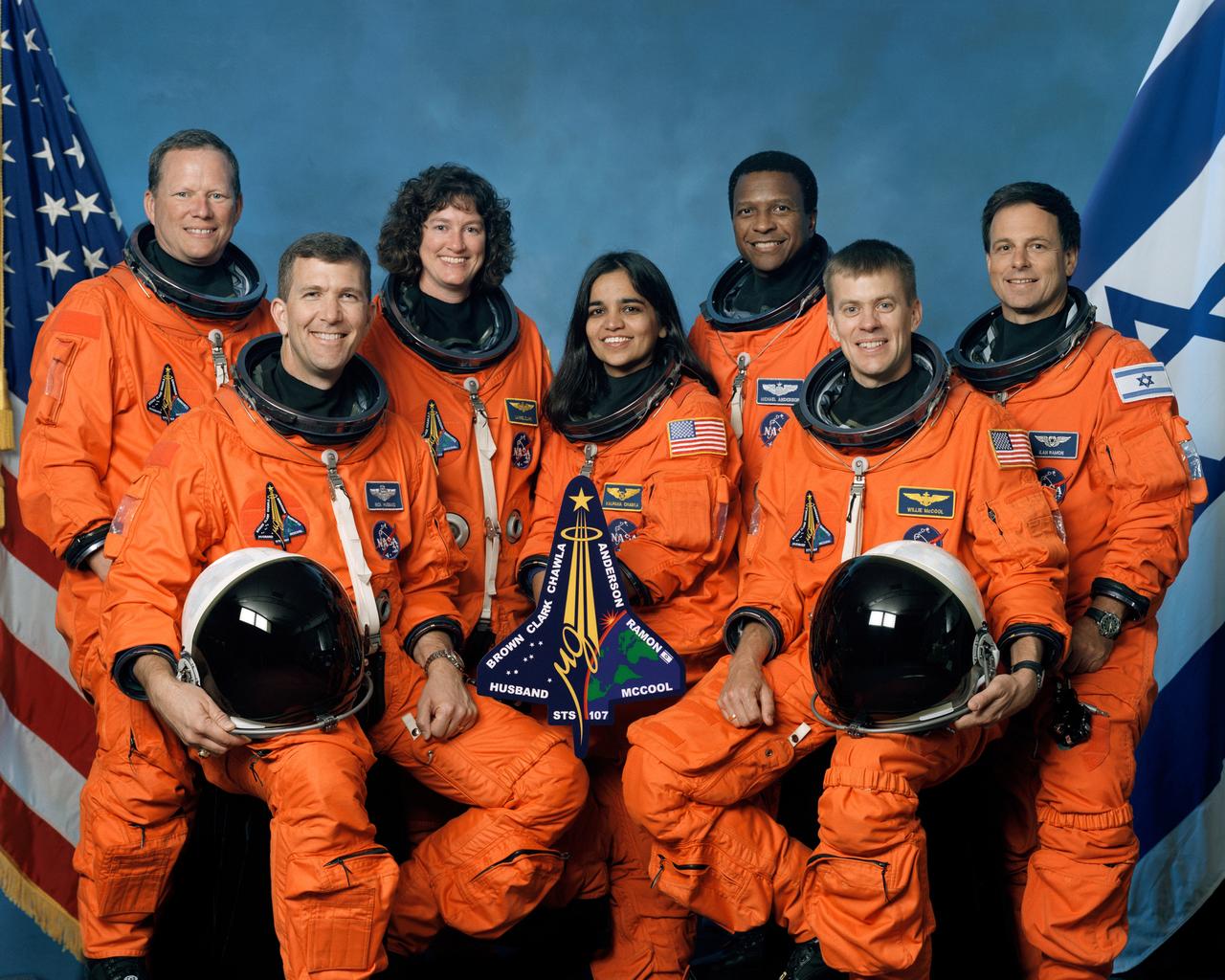
On February 1, 2003, Space Shuttle Columbia broke apart during re-entry over Texas and Louisiana, just 16 minutes before its scheduled landing at Kennedy Space Center. All seven crew members were lost: Commander Rick Husband, Pilot William McCool, Mission Specialists Michael Anderson, David Brown, Kalpana Chawla, and Laurel Clark, and Payload Specialist Ilan Ramon — the first Israeli astronaut.
STS-107 had been a remarkably successful 16-day science mission. Launching on January 16, 2003, the crew worked around the clock in two shifts, conducting more than 80 experiments in the SPACEHAB Research Double Module. Their work spanned materials science, fluid physics, combustion science, life sciences, and Earth observation. The crew was returning home with a wealth of scientific data when disaster struck at 9:00 AM EST, at an altitude of 207,135 feet and a velocity of Mach 18.3.
Their sacrifice is remembered alongside those of Apollo 1 and Challenger as a reminder of the risks inherent in human spaceflight, and of the courage required to accept those risks in the pursuit of knowledge.
STS-107 had been a remarkably successful 16-day science mission. Launching on January 16, 2003, the crew worked around the clock in two shifts, conducting more than 80 experiments in the SPACEHAB Research Double Module. Their work spanned materials science, fluid physics, combustion science, life sciences, and Earth observation. The crew was returning home with a wealth of scientific data when disaster struck at 9:00 AM EST, at an altitude of 207,135 feet and a velocity of Mach 18.3.
Their sacrifice is remembered alongside those of Apollo 1 and Challenger as a reminder of the risks inherent in human spaceflight, and of the courage required to accept those risks in the pursuit of knowledge.
“The crew of the shuttle Columbia did not return safely to Earth; yet we can pray that all are safely home.”
— President George W. Bush, February 1, 2003
The Crew
What Happened
The Foam Strike
On January 16, 2003, Columbia launched from Kennedy Space Center’s LC-39A on its 28th and final mission. Approximately 81.7 seconds after liftoff, a large piece of insulating foam broke free from the External Tank’s bipod ramp — the attachment point between the tank and the orbiter. The foam, estimated to weigh about 1.67 pounds and measuring roughly 24 by 15 inches, struck Columbia’s left wing at a relative velocity of about 545 miles per hour.The impact breached the wing’s Reinforced Carbon-Carbon (RCC) thermal protection panels near the leading edge, creating a hole estimated to be 6 to 10 inches in diameter. Engineers at NASA noticed the foam strike on Day 2 of the mission through review of launch film, and a Debris Assessment Team was convened. However, management decisions prevented the team from obtaining satellite or on-orbit imagery that could have confirmed the damage. Three separate requests for Department of Defense imaging of Columbia’s wing were made and then cancelled by NASA management.
Re-entry and Breakup
On February 1, 2003, Columbia began its re-entry into Earth’s atmosphere at 8:44 AM EST. As the orbiter descended, superheated plasma at temperatures exceeding 3,000°F entered through the breach in the left wing’s leading edge. The intense heat progressively melted the wing’s internal aluminum structure, severing wiring bundles and causing a cascade of sensor failures that were visible in Mission Control telemetry.At 8:59:32 AM EST, at an altitude of 207,135 feet over north-central Texas, Columbia experienced a sudden loss of control. The vehicle broke apart, scattering debris over a corridor stretching from eastern Texas into western Louisiana. All seven crew members perished. Mission Control lost all contact and data at that moment. The last communication from Commander Husband was a calm, incomplete transmission: “Roger, uh, buh—”
The Investigation
The Columbia Accident Investigation Board (CAIB), chaired by retired Admiral Harold Gehman, conducted a seven-month investigation. The Board’s final report, released on August 26, 2003, identified both the physical cause — the foam strike and resulting RCC panel breach — and deep organizational failures within NASA that allowed the risk to go unaddressed. The CAIB found that NASA’s culture had normalized the foam shedding problem, treating it as a maintenance issue rather than a safety-of-flight concern despite 113 shuttle flights experiencing some form of foam loss.Over 84,000 pieces of Columbia debris were recovered across east Texas and Louisiana in one of the largest ground search operations in U.S. history, covering more than 2.3 million acres. The remains of all seven crew members were recovered and returned to their families.
Legacy
Return to Flight
The Space Shuttle fleet was grounded for over two years following the Columbia disaster. NASA implemented sweeping changes based on the CAIB’s 29 recommendations. New External Tank foam application procedures were developed to reduce foam shedding. An extensive on-orbit inspection capability was created, including the Orbiter Boom Sensor System (OBSS) — a 50-foot extension of the Shuttle’s robotic arm equipped with laser scanners and cameras to inspect the heat shield after every launch. Pre-planned repair techniques for damaged thermal tiles and RCC panels were developed and certified.The Return to Flight mission, STS-114 aboard Discovery, launched on July 26, 2005. Commander Eileen Collins performed a dramatic backflip maneuver so that ISS crew members could photograph Discovery’s underside, a new procedure that became standard for all subsequent missions. The Shuttle flew 22 more missions to complete assembly of the International Space Station before the program ended in July 2011.
Organizational Reform
The CAIB report fundamentally changed NASA’s safety culture. An independent NASA Engineering and Safety Center (NESC) was established. The Columbia Crew Survival Investigation Report, released in 2008, provided detailed analysis of the breakup sequence and crew survivability, leading to improvements in crew escape systems and protective equipment across all human spaceflight programs.Remembering the Crew
The seven crew members of STS-107 are honored at the Space Mirror Memorial at Kennedy Space Center Visitor Complex, alongside the crews of Apollo 1 and Challenger. Seven asteroids were named for the crew. Columbia Hills on Mars, explored by the Spirit rover, are named for the seven astronauts. The SPACEHAB module that the crew worked in during the mission — and much of the scientific data they collected — was recovered from the debris field, ensuring their research contributions were preserved.Each year on the NASA Day of Remembrance, held on or near January 27, the agency honors all those who gave their lives in the pursuit of space exploration. The Columbia crew’s names join those of Grissom, White, Chaffee, and the Challenger seven as a permanent reminder of the cost and the courage of human spaceflight.
Documentary
Photo Gallery