Completed — 1969
Apollo 12
Pinpoint Landing
Nov 14 — Nov 24, 1969
10 days, 4 hours, 36 minutes
Apollo 12 Trajectory Replay — Top View
Pre-Launch
Day 0 of 10
10d 4h 36m
Mission Duration
~248,000mi
Max Distance from Earth
~31.5hrs
Time on Lunar Surface
2 EVAs
7 Hours 45 Min Total EVA
75lbs
Lunar Samples Collected
On Foot
No Lunar Rover
Nov 14, 1969
Launch — 11:22 AM EST
Nov 24, 1969
Splashdown — 3:58 PM EST
USS Hornet
Recovery — South Pacific
Mission Summary
Apollo 12 was the second crewed mission to land on the Moon, launched on November 14, 1969, just four months after Apollo 11 made history. Commanded by Charles “Pete” Conrad with Richard Gordon as Command Module Pilot and Alan Bean as Lunar Module Pilot, the all-Navy crew brought a spirit of camaraderie and humor that defined the mission from start to finish. Just 36 seconds after liftoff, the Saturn V was struck by lightning — and struck again at 52 seconds — knocking out telemetry and fuel cells. Flight controller John Aaron’s legendary call “SCE to AUX” and Bean’s quick action on an obscure switch saved the mission from what could have been an abort.
The crew demonstrated precision navigation by landing the Lunar Module Intrepid within 600 feet of the unmanned Surveyor 3 probe, which had been sitting on the lunar surface since April 1967. This pinpoint landing proved that NASA could target specific locations on the Moon — a critical capability for future missions to more challenging terrain. Conrad’s first words on the surface were characteristically irreverent: “Whoopee! Man, that may have been a small one for Neil, but that’s a long one for me.”
Over two EVAs totaling 7 hours and 45 minutes, Conrad and Bean deployed the Apollo Lunar Surface Experiments Package (ALSEP), collected 75 pounds of lunar samples, and walked to Surveyor 3 to retrieve its camera and other parts — the first time hardware was returned from another world. Analysis later revealed Earth bacteria (Streptococcus mitis) had survived inside the camera for over two years on the lunar surface, though this finding remains debated.
Apollo 12 splashed down safely in the South Pacific on November 24, 1969, and was recovered by the USS Hornet — the same carrier that had recovered Apollo 11 just four months earlier. The mission proved that pinpoint landings were achievable, paving the way for the more ambitious geological explorations of later Apollo missions.
The crew demonstrated precision navigation by landing the Lunar Module Intrepid within 600 feet of the unmanned Surveyor 3 probe, which had been sitting on the lunar surface since April 1967. This pinpoint landing proved that NASA could target specific locations on the Moon — a critical capability for future missions to more challenging terrain. Conrad’s first words on the surface were characteristically irreverent: “Whoopee! Man, that may have been a small one for Neil, but that’s a long one for me.”
Over two EVAs totaling 7 hours and 45 minutes, Conrad and Bean deployed the Apollo Lunar Surface Experiments Package (ALSEP), collected 75 pounds of lunar samples, and walked to Surveyor 3 to retrieve its camera and other parts — the first time hardware was returned from another world. Analysis later revealed Earth bacteria (Streptococcus mitis) had survived inside the camera for over two years on the lunar surface, though this finding remains debated.
Apollo 12 splashed down safely in the South Pacific on November 24, 1969, and was recovered by the USS Hornet — the same carrier that had recovered Apollo 11 just four months earlier. The mission proved that pinpoint landings were achievable, paving the way for the more ambitious geological explorations of later Apollo missions.
NASA Mission Overview
Mission Timeline
Mission Complete
Mission Gallery
Crew
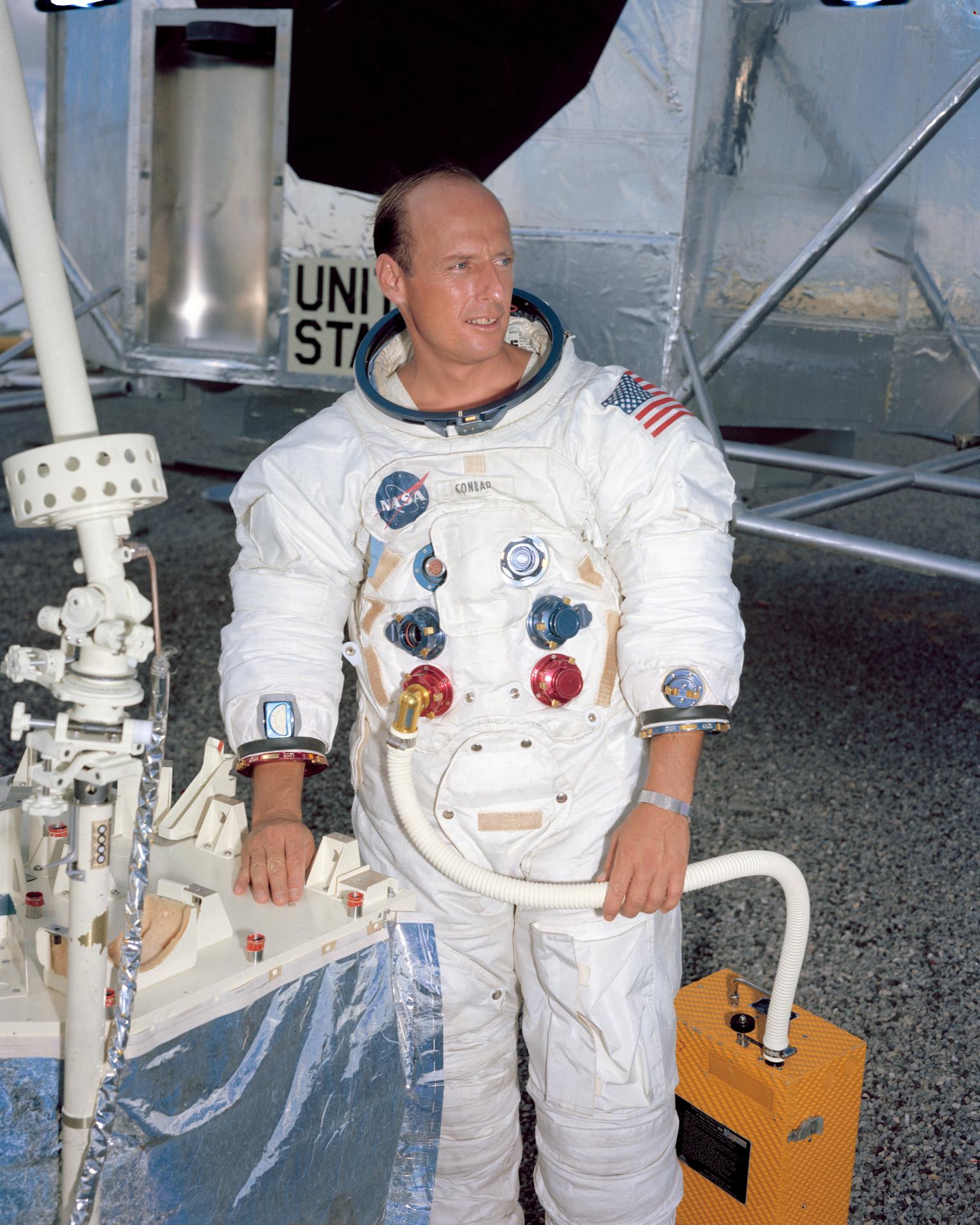
Pete Conrad
Commander
Third person to walk on the Moon

Richard Gordon
Command Module Pilot
Orbited Moon solo in Yankee Clipper

Alan Bean
Lunar Module Pilot
Fourth person to walk on the Moon