In Memoriam — 1967
Apollo 1
Ad Astra Per Aspera
January 27, 1967
AS-204 — Cape Kennedy LC-34
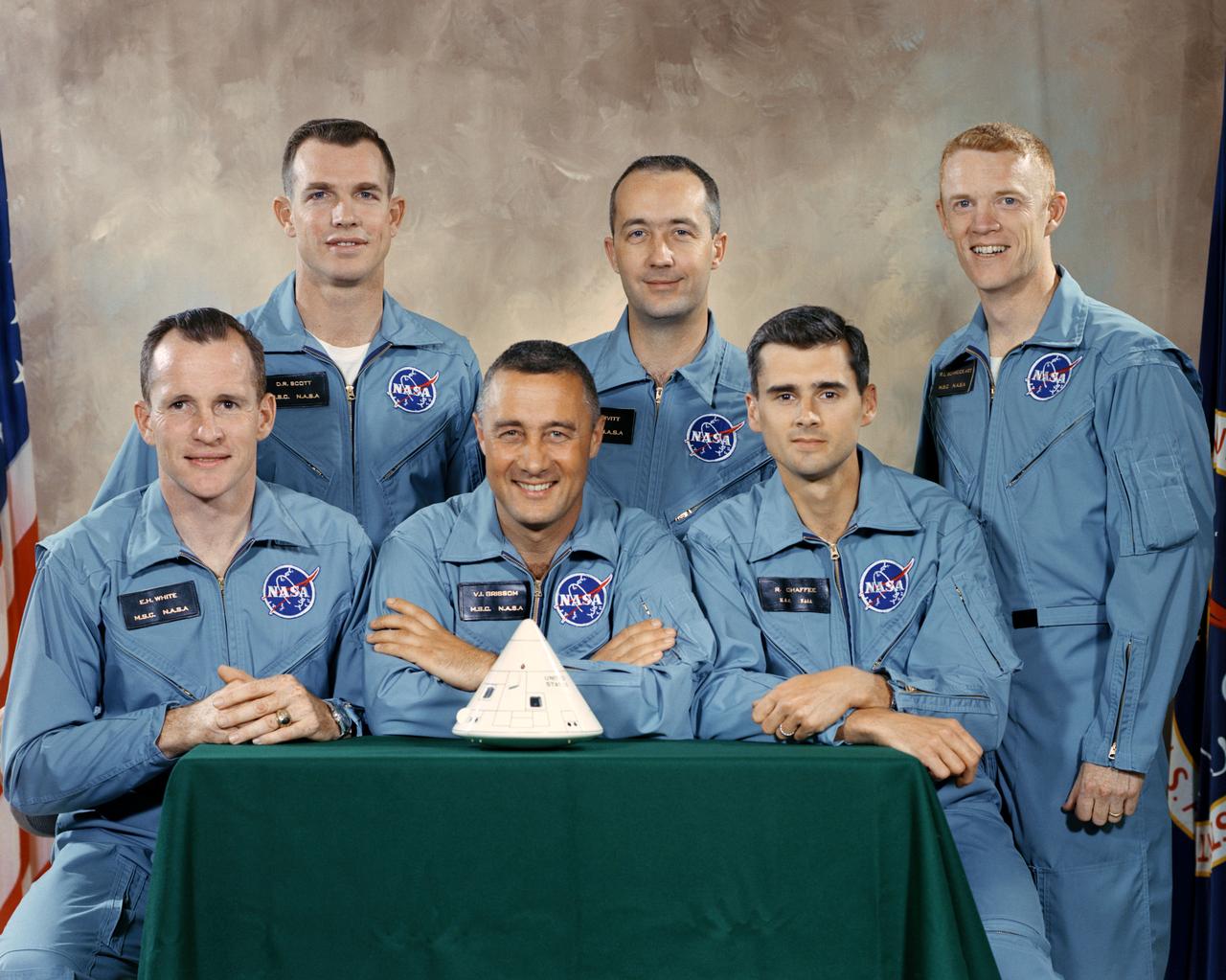
On January 27, 1967, a flash fire swept through the Apollo 1 Command Module during a routine launch pad test at Cape Kennedy Launch Complex 34, killing all three crew members: Command Pilot Virgil I. “Gus” Grissom, Senior Pilot Edward H. White II, and Pilot Roger B. Chaffee. They were the first Americans to give their lives in the direct pursuit of spaceflight.
The mission, designated AS-204, was to have been the first crewed flight of the Apollo spacecraft, planned for launch on February 21, 1967. Instead, it became the crucible through which the Apollo program would be forged. The tragedy exposed critical design flaws, led to sweeping safety reforms, and ultimately made possible the six successful lunar landings that followed. The name “Apollo 1,” chosen by Grissom, White, and Chaffee themselves, was officially designated by NASA in their honor.
Their sacrifice is remembered not as a failure, but as the price paid to reach the stars. The lessons learned from their loss saved countless lives and gave humanity the Moon.
The mission, designated AS-204, was to have been the first crewed flight of the Apollo spacecraft, planned for launch on February 21, 1967. Instead, it became the crucible through which the Apollo program would be forged. The tragedy exposed critical design flaws, led to sweeping safety reforms, and ultimately made possible the six successful lunar landings that followed. The name “Apollo 1,” chosen by Grissom, White, and Chaffee themselves, was officially designated by NASA in their honor.
Their sacrifice is remembered not as a failure, but as the price paid to reach the stars. The lessons learned from their loss saved countless lives and gave humanity the Moon.
“If we die, we want people to accept it. We are in a risky business, and we hope that if anything happens to us it will not delay the program. The conquest of space is worth the risk of life.”
— Gus Grissom
The Crew
What Happened
The Plugs-Out Test
On the afternoon of January 27, 1967, the Apollo 1 crew entered their Command Module atop a Saturn IB rocket at Launch Complex 34 for a “plugs-out” test — a full dress rehearsal designed to verify that the spacecraft could operate on internal power alone after all external connections were disconnected. The test was classified as non-hazardous because neither the launch vehicle nor the spacecraft was fueled. The crew sealed the hatch and the cabin was pressurized with 16.7 psi of pure oxygen, a standard procedure at the time.From the start, the test was plagued by communications problems between the spacecraft, the operations building, and the blockhouse. At one point, a frustrated Grissom remarked, “How are we going to get to the Moon if we can't talk between two or three buildings?” The countdown was held at several points to troubleshoot the issues.
The Fire
At 6:31 PM EST, after nearly six hours in the sealed cabin, a voltage transient was recorded in the spacecraft wiring. Seconds later, a voice — likely Chaffee — called out, “Hey!” followed by another voice: “We've got a fire in the cockpit.” Within seconds the call became desperate: “We have a bad fire! We're burning up!”In the 100% oxygen atmosphere at high pressure, the fire spread with terrifying speed. Flames engulfed the cabin in less than 25 seconds. The crew struggled to open the inner hatch, but the Block I Apollo hatch was a complex three-piece design that opened inward, held shut by the higher internal pressure. By the time pad workers fought through dense smoke to reach the spacecraft and open the hatch — nearly five minutes after the first alarm — the crew had perished. The official cause of death was asphyxiation due to toxic gases from the fire, with thermal burns as a contributing factor.
The Investigation
NASA convened a seven-member Apollo 204 Review Board, chaired by Dr. Floyd L. Thompson of Langley Research Center. Both houses of Congress launched their own investigations. The Board’s final report, released on April 5, 1967, identified the most probable ignition source as an electrical arc near Grissom’s couch in an area containing vulnerable wiring bundles. The fire was fed by extensive use of flammable Velcro, nylon netting, and other combustible materials throughout the cabin, all intensified by the pure oxygen environment at higher-than-atmospheric pressure.The investigation uncovered over 1,400 wiring anomalies in the Command Module and revealed systemic problems with quality control and safety oversight at prime contractor North American Aviation. The report did not assign individual blame but acknowledged collective failures across NASA and its contractors.
Legacy
Redesigning for Safety
The Apollo 1 fire triggered the most comprehensive spacecraft redesign in NASA history. The Block II Command Module incorporated over 1,300 design changes, including:• A new unified hatch that opened outward and could be operated in less than 10 seconds, replacing the cumbersome inward-opening multi-piece design
• Replacement of the 100% oxygen launch atmosphere with a 60/40 oxygen-nitrogen mix at sea level, transitioning to pure oxygen only at the reduced pressure of space
• Removal or replacement of all flammable materials with fire-resistant alternatives throughout the cabin
• Redesigned wiring with improved insulation and routing, protected by stainless steel covers
• A completely overhauled quality control process with stricter documentation and independent safety reviews
• Installation of an emergency cabin vent system to rapidly depressurize in case of fire
The Path to the Moon
The redesigned spacecraft that emerged from this tragedy was fundamentally safer and more reliable than what had come before. Many engineers and astronauts would later acknowledge that without the painful lessons of Apollo 1, the program might not have succeeded. The 20 months between the fire and the first crewed Apollo flight (Apollo 7 in October 1968) were spent in relentless review and improvement. Within two years of the fire, Apollo 11 landed on the Moon.The Block II Command Module proved its worth again and again — most dramatically during Apollo 13, when the redesigned spacecraft brought its crew home safely after a catastrophic explosion in the Service Module.
Remembering
Launch Complex 34 was decommissioned in 1969. The launch pedestal still stands, marked with two plaques. One reads: “Ad Astra Per Aspera” — through hardships to the stars. The other bears the names of Grissom, White, and Chaffee, with the words: “In memory of those who made the ultimate sacrifice so others could reach for the stars. Ad Astra Per Aspera. God speed to the crew of Apollo 1.”The crew’s legacy extends beyond Earth. Three hills near the Mars Pathfinder landing site were named Grissom, White, and Chaffee. Craters on the Moon bear their names. Each January 27, NASA holds a Day of Remembrance honoring them alongside the crews of Challenger and Columbia.
In 2017, on the 50th anniversary of the fire, NASA opened the “Ad Astra Per Aspera” tribute exhibit at Kennedy Space Center, displaying the Apollo 1 hatch to the public for the first time, with the blessing of the astronauts’ families.
Documentary
Photo Gallery